
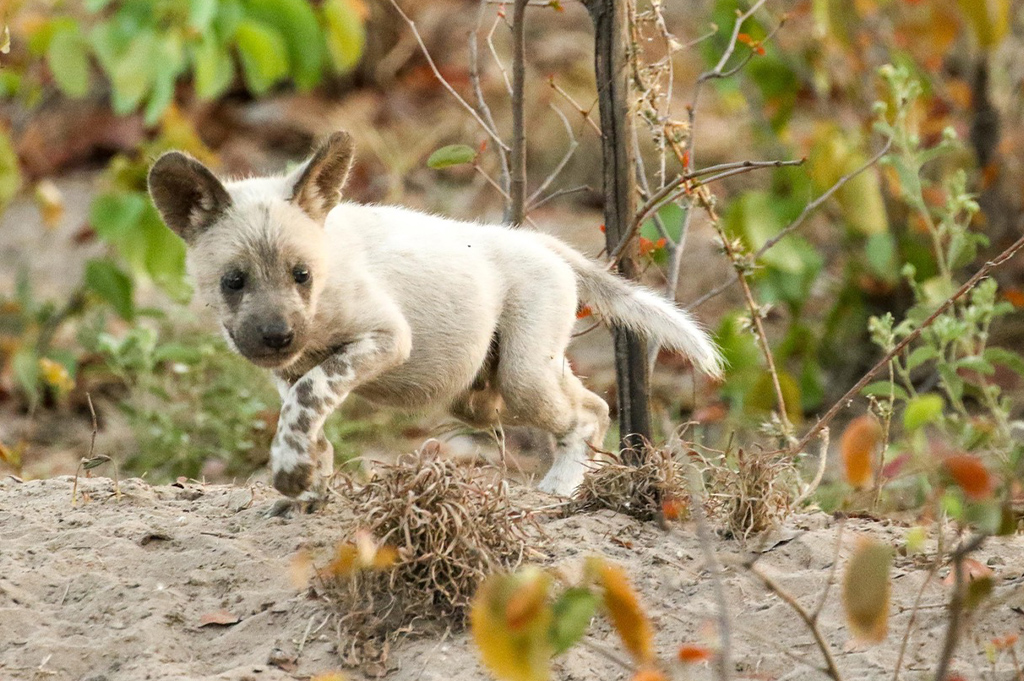
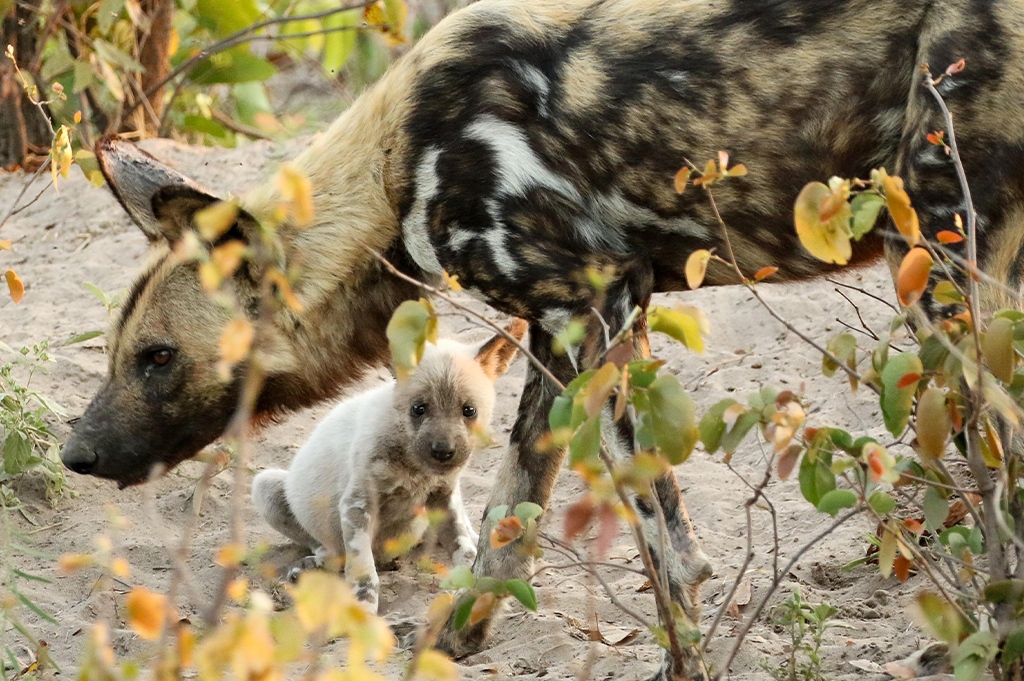
You might have seen the photos we posted recently of an unusually pale African wild dog pup near Tuludi in Khwai Private Reserve, Botswana. “Unusually pale” is an understatement. This is the lightest dog any of us at Natural Selection have ever seen, and we have a great many bush years between us.
“That is the most leucistic dog ever,” exclaimed Dr John ‘Tico’ McNutt, Director of our partners Wild Entrust. “It’s extraordinary!”
But the pup is only part of the story. Wild dogs are changing the way they breed, and the reason is a warning for the whole species.
A very pale pup
Leucism, a partial loss of pigmentation, is not the same as albinism: leucistic animals keep their normal eye colour. Tico, one of the world’s foremost wild dog researchers, has seen it before. In Kwando, in far northern Botswana, a litter born in 2003 caught his eye because two of the eight pups were leucistic. He has followed such cases ever since, tracing a number of them back to that same Kwando lineage. Descendants of that litter moved through to the Vumbura region in 2008 and, over the next 15 years, dispersed through Maunachira and on to Khwai, where this little Tuludi pup popped up.
It isn’t only in Botswana that pale pups are being seen. Tico was also sent the photo below of a clearly leucistic dog in the Democratic Republic of the Congo.
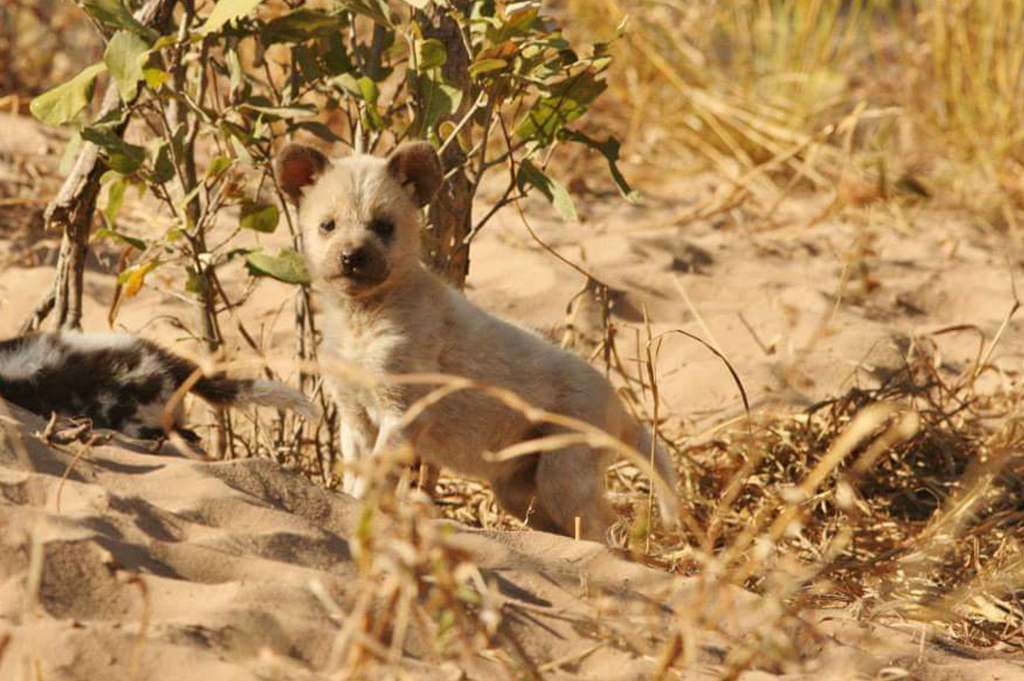
[Photo: A leucistic pup in Kwando, 2015.]
More mothers than expected?
Pale pups aren’t the only development piquing interest in the wild dog world. The African wild dog is a co-operative species that looks after its young, old and weak, working together as something of a family unit. It’s typically reported that only the dominant male and female breed, while the rest of the pack helps to rear the pups. But guides have been seeing multiple females in a pack produce litters. This comes as no surprise to Tico.
“We have always seen subdominant females (perhaps in most packs) cycling – usually about four weeks after the dominant female has cycled, and showing full pregnancy,” he explains. “These subdominant females can and often do produce pups, but in the past, and in habitats typical of ecosystems with a healthy, intact predator guild population, most of these secondary litter pups are never seen because they don’t survive long enough.”
(A predator guild is the group of different predator species within an ecological community that use the same resources.)
There are, however, circumstances in which those pups might survive, for example when lion numbers are very low and prey numbers are high. In those conditions, secondary litters can survive, and have been seen to.
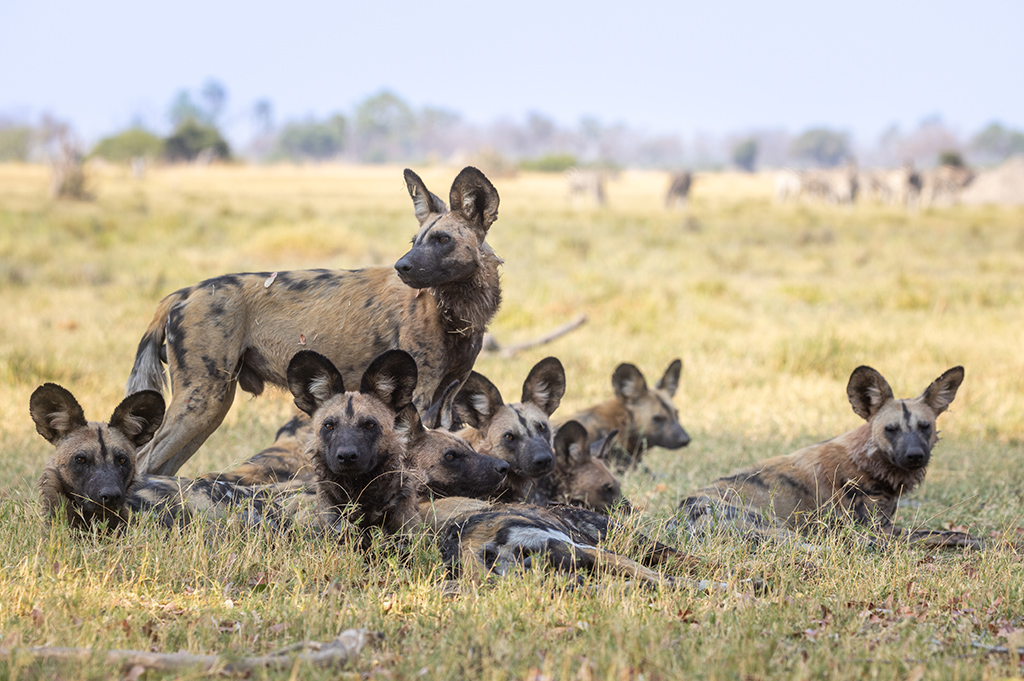
“Recall the Mombo pack in 1994,” notes Tico. “There were five pregnant females – all sisters, and three contributed to a collective litter of 24 pups that was managed by both the dominant female and her closest (littermate) sister. In all, we have reported that as many as 38% of reproductively active packs have produced secondary litters, and a recent paper by some colleagues in Zimbabwe have reported 41.5% with high survival in the Savé Conservancy.”
Tico has reviewed the Zimbabwe paper and asked for an analysis comparing its lion and prey densities with those of other sites, which would help build the research Wild Entrust have been doing. Until then, we simply don’t know whether changes in those densities are enabling more multiple litters.
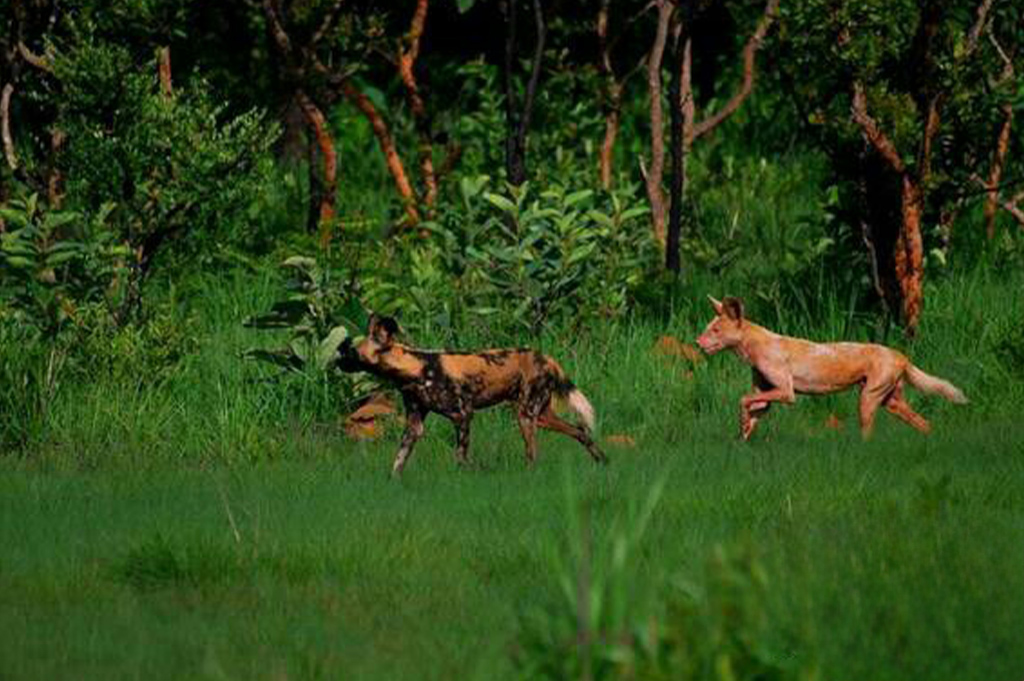
[Photo: A leucistic dog in Chinko, Democratic Republic of the Congo. Yannick Exalto]
A shifting calendar
Another aspect of wild dog behaviour that seems to be changing is the timing of reproduction. Tico has researched this extensively and written papers on it, and he believes the changes are almost certainly due to climate change.
In the paper ‘Ambient temperature provides an adaptive explanation for seasonal reproduction in a tropical mammal’, published in the Journal of Zoology, Tico, R. Groom and R. Woodroffe found that wild dogs time their breeding to coincide with the coolest temperatures. Most warm-blooded animals shift their breeding around the availability of food. But wild dogs hunt in the daytime, and hunting in the heat is difficult, so temperature, rather than food, sets their calendar. That leaves them exposed to global warming.
Dogs living further from the equator stick to breeding during the coolest weeks of the year, giving their pups the best chance of survival. Dogs living at the equator breed year-round, because they don’t experience the same temperature fluctuations. As temperatures rise, this ‘cool window’ is becoming harder to find, making survival even more difficult for an already Endangered species.
African wild dogs in northern Botswana have delayed their birthing dates by an average of 7 days per decade, a shift of 22 days over 30 years. Wild Entrust, along with researchers from the University of Washington, found that while birthing dates moved to sync with cooler temperatures, temperatures during the critical denning period rose over the same timeframe, putting the newborn period into a hot window. Over the 30-year study period, average daily maximum temperatures rose by around 1.6°C.
This is known as a ‘phenological trap’: when a species changes the timing of a major life event, such as migration, birthing or hibernation, in response to an environmental cue, only for the change to become maladaptive because of unexpected changes in climate. According to the researchers, this is the first time a climate-driven phenological shift has been documented in a large mammalian carnivore.
Briana Abrahms, assistant professor of biology at the University of Washington and researcher with the Center for Ecosystem Sentinels, credited Wild Entrust’s work when she spoke to the World Economic Forum: “We could only conduct this study because of the existence of this unique, long-term dataset for a large predator, which is really rare. It shows the value for this kind of data in studying how climate change will impact ecosystems.”
Researching a changing landscape
It will come as no surprise that climate change hangs heavy over the world of conservation, and we have a project well under way in the Makgadikgadi Pans. Our Impacts of Surface Water on Herbivore Ecology and Socio-Ecological Knock-On Effects project looks at the surface water available in the region, and its impact on the ecosystem, amid soaring temperatures and decreased rainfall.
“It’s no longer possible to study any species, habitat or ecosystem without considering climate change,” explains our Director of Conservation, Dr Jennifer Lalley. “It now competes with habitat loss as the main driver of species extinction. But where habitat loss was combatable at a local scale, climate change is out of the hands of the local conservationist. It’s up to our global community to change it. What we can do is try to mitigate the impacts as best we can.”
The world is changing, and not all species will be able to adapt. It is our great hope that, through support of NGOs such as Wild Entrust, we can help carve out a future for the species that have lived in these areas for so long, whatever colour form they might take.
CLICK HERE to Support our work
See wild dogs for yourself: reservations@naturalselection.travel