
Today we know this Kalahari icon as Jack’s Camp, but back in the 60s it was known as Bushman Bed Camp and it was indeed Jack Bousfield’s camp.
“Dad just loved this spot,” explains Jack’s daughter Debbie. “Not only had he trapped here over 63 years ago, but it’s also where he shared his precious last moments with his late brother Don on a safari expedition in 1963.” Debbie is the fourth born of Jack’s five children (the youngest is our very own Ralph), born in Mbeya, Tanganyika,” Debbie tells us.
“As the two of us (Debbie and Ralph) were the last to fledge the nest we had two or three years extra at primary school in Francistown before we left home and the bush for boarding school in South Africa. During this time, fortunately, we had pretty regular contact with Dad.”
Bushman Bed Camp was a very different offering to the opulent accommodation we know and love today and the main draw card for the friends and family who loved to visit was Jack himself.
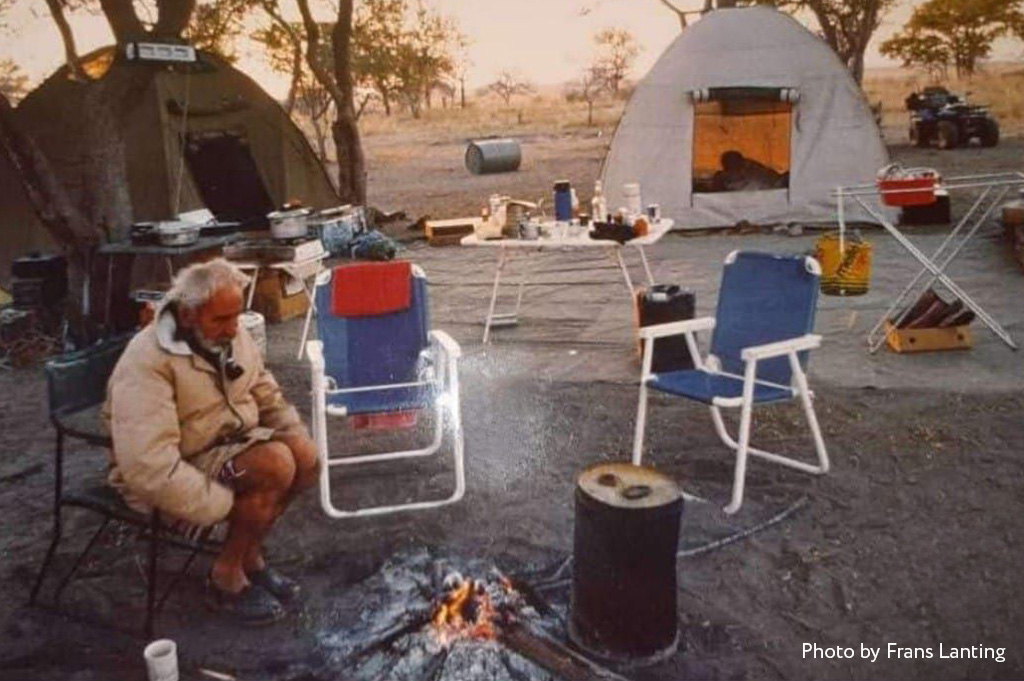
“In those days one would approach BBC (as the camp was affectionately known) from the East, driving over the shimmering pans on a raised calcrete road which Dad and his main camp assistant Bee had painstakingly constructed and would patch before the rains to prevent them getting waterlogged and vehicles getting stranded. Bee was a tall gangling Motswana youth with a big white toothy smile. He had a great sense of humour and he and Dad would always joke together. Dad would pull his leg and Bee would giggle uncontrollably. They had a good understanding and mutual respect,” Debbie recalls. “You’d aim for the huge canopy of shade cast by the spectacular Camel Thorn tree. Here Dad had his living quarters; a rudimentary bedroom and kitchen which were set up exactly where the Uncharted Africa office is today.”
Jack survived out here along with his ‘right hand man Sam’, a Motswana gentleman named Samwelli Jeremiah, with whom Jack would converse in Swahili and whom Debbie last saw seven years ago, before he retired to his village. Among their homewares was a small fridge, gas stove, campfire and a non-negotiable radio. “He used his Barlow Wadley radio to pick up debates and discussions from around the world,” smiles his daughter. “BBC World News was his mainstay. He was up to date with world affairs, cutting edge innovations and fashions – more so from the heart of the bush than many upwardly mobile folk I knew in the city!”
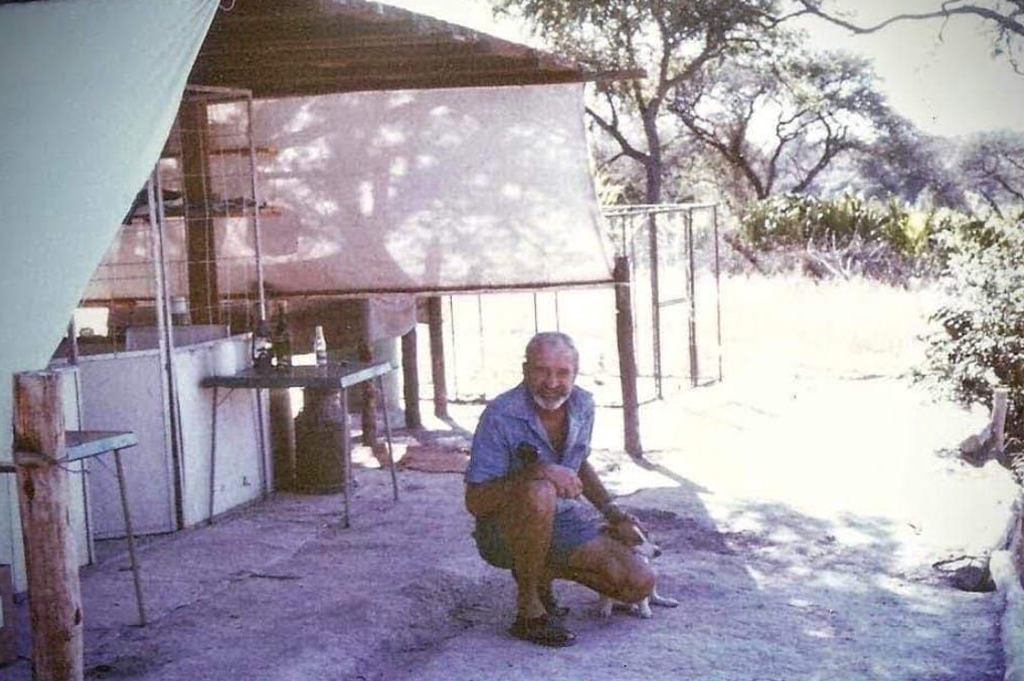
It was not only the outside world at large that Jack kept in touch with from here, he was also a devoted family man who, despite opting for a life in the wilderness, kept in close contact with his wife, Nicky, and their five enormously loved children. This was achieved through World War II two-way radio telephones. “The aerial mast was high up in the tree boughs and it ran along the ground for improved reception,” notes Debbie. “This kept us all in contact: Mum in Francistown relaying the messages to the five of us children in our various ports.”
These lines of communication always stayed open and alive, as did the campfire. “There were always wispy swirls of campfire smoke beneath the tree, along with smouldering embers,” adds Debbie. “It was around that fire that life happened and it was never completely extinguished. The fire was encircled by logs for everyone to sit on and the floor was a beautiful carpet of discarded bark chips from the Camel Thorn – gnarled dusty grey on one side, streaked by bright russet and melted chocolate on the other. Strewn randomly across the top were large, fist-sized seed pods, like giant silky Galago ears, and the tree itself was alive with creatures: nesting birds, bushbabies, vine snakes, hairy caterpillars and Mopani moths.”
The name of the camp, Bushman Bed Camp, BBC, was unusual, and garnered from the antique Bushman bed which was suspended high up in the branches in the fork of the tree by tungsten strong doum palm fronds which were woven into plaited ropes. “They were beautifully made and bleached white from the sun and salt,” remembers his fourth born. “It was high above the countryside and wild animals for nightly vigil and protection. The tree house of all tree houses!” The remnants of this lookout were still evident until quite recently.
“We’d park our vehicles in front of a white ant mound which had virtually engulfed the palm tree beside it like a hungry Pacman,” grins Debbie. “Dad always greeted us warmly with a twinkle in his blue eyes, a huge Meerschaum pipe clenched between his teeth and a ‘yeh yeh yeh – my monkeys, you made it at last… about bloody time!’ Dad was quietly spoken. His presence was gentle but all encompassing.”
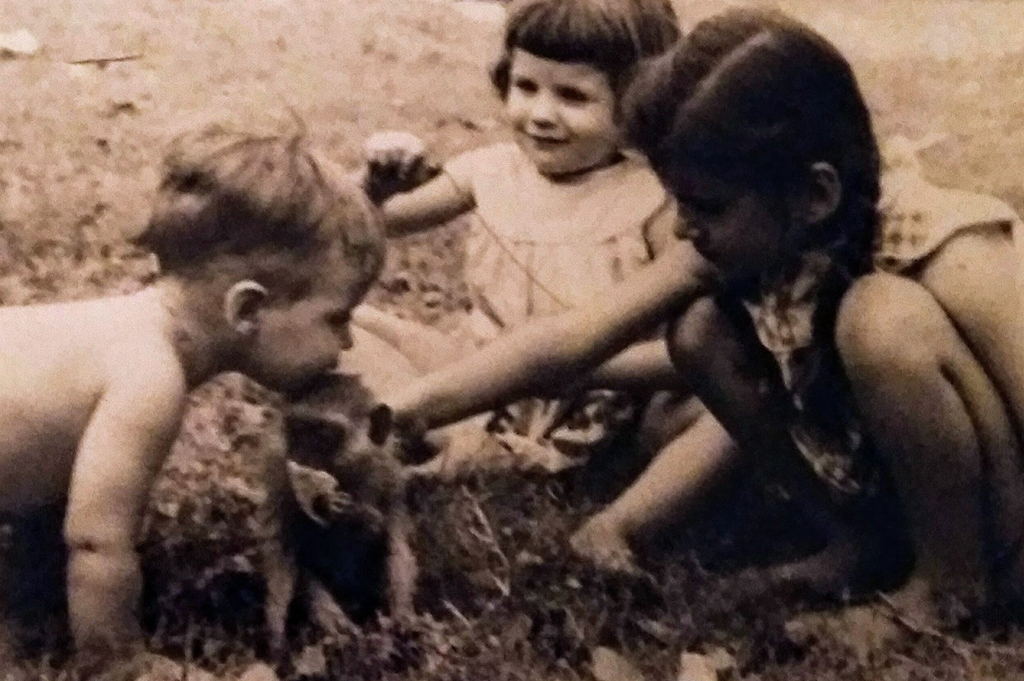
Nowadays Jack’s Camp offers vast bedroom suites that extend to 270 square metres, but that wasn’t always the case. “You’d follow baking hot sand tracks around to where the vehicle repair area is now and you’d come to beautifully swept and cleaned housing in the shape of six numbered bow tents on large green canvas ground sheets,” Debbie muses. “This was for guests. It was basic, but comfortable enough. There were canvas basins with wooden Mukwa framed shaving mirrors, an ingenious canvas pulley shower system holding 10 litres of hot water which was boiled in a 44 gallon drum on the campfire. There were Hounsfield beds, bed rolls and Gogo stools – all authentic, well-worn personal possessions. These elements formed the nucleus of the 1940s campaign style – it was developing back then and is fully formed at Jack’s Camp today.”
The camp guests visit today tells the story of both the Makgadikgadi area and the Bousfield family history – it also incorporates one of Botswana’s most comprehensive collections of ancient artefacts in its Natural History Museum. The 1940s campaign style pieces had been collected and curated by the family over decades and Debbie clearly remembers the beginnings of this fascinating assemblage. “There were leftovers from Dad’s own Second World War campaigns into Abyssinia, Sudan and other parts of Africa, as well as his kit from his own high-end safaris in Tanganyika during the 1940s and 50s. During these safaris he entertained many well-known world leaders, authors, socialites, Hollywood stars, reprobates and characters. Particularly noteworthy were Clarke Gable, Frank and his daughter Nancy Sinatra, Grace Kelly, Robert Ruark, Lee Radziwill, Ava Gardner and Ernest Hemingway.”
Jack’s military interests were sparked in 1938 when he was still at school. The RAF were seeking new recruits following Neville Chamberlain’s ‘Peace for our time’ declaration. “Dad’s father, Major Ralph Alexander Bousfield encouraged both Dad and his brother Don to volunteer and drove them to Nairobi from Arusha School, to apply” explains Debbie. “They longed to fly, but both boys were found to be slightly colour blind so, much to their disappointment, their applications were rejected. He fibbed about his age to get into the army at the age of 16 and joined the East African Reconnaissance (RECCIES) in the Northern Frontier District (NFD). He fought in the Somaliland Campaign and Abyssinian Campaign. In 1942 they were sent to the Far East to fight in Ceylon, India and Burma where they stayed until the atomic bomb was dropped in Japan in 1945.”
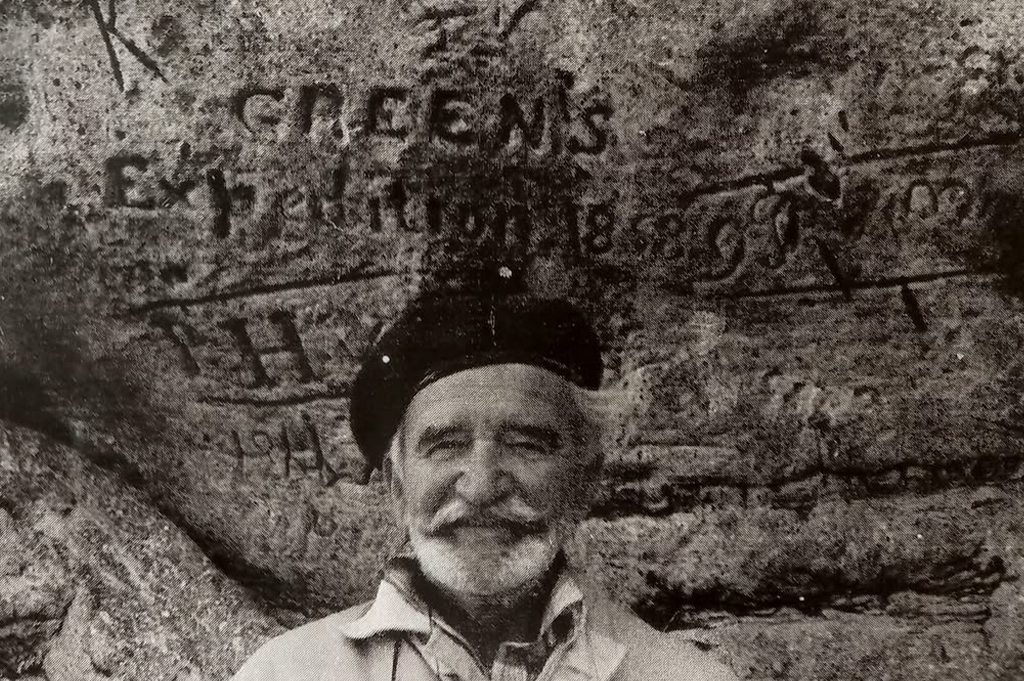
It wasn’t only the military paraphernalia that carried a sense of nostalgia but also Jack’s own turn of phrase. “He used all the military terms ‘mess tent’, ‘scoff’, ‘kit’, ‘puttees’, coupled with Swahili terms such as ‘panga’, ‘siagi’, ‘kuni’, ‘pilipili’ and they all rolled off his tongue as easily as the word ‘safari’ might off yours. The 1940s aesthetic is totally authentic and comes from intensely personal experiences. It’s all part of who Jack Henry Bousfield genuinely was.”
His five offspring looked forward to their visits with eager anticipation and a particular highlight was a palm-fringed enclave containing an array of bikes. “It was a Heath Robinson assortment of four-wheeler bikes. There were six in total, of all shapes, sizes, makes and colours – no two were the same. Dad urged you – and celebrated the idea – that you could just take a bike from the selection at any time, day or night (although he always made sure we had water lashed to the back of the bike), ride out to the Pans and just go… let go… without a worry in the world, like Easy Rider, or Riders of the Storm perhaps! The baking hot sun and fine salt dust filled the lines and creases of our faces and the smell of far off rain and dust pricked our nostrils. You’d detect a faint hint of antelope on the wind, and wind and dust would whistle through your hair on the mirror flat surface. You could close your eyes, hand fully open on the throttle and dream you were flying through space.”
These were magical times for the Bousfield kids and Jack obviously revelled in showing his children the sensory expanse that he so loved.
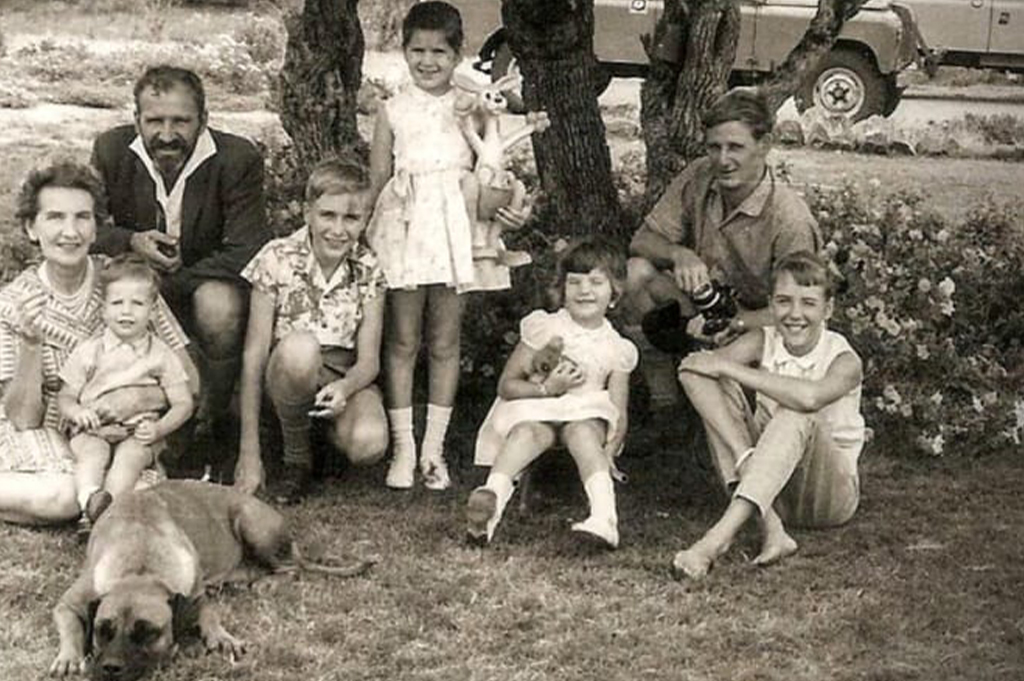
“This is a spiritual site for sure,” his daughter sighs. “The nights were peppered with the sounds of black-backed jackal, hyena or a lion’s roar in the distance. Dad loved to share the campfire with us and watch the stars. He always needed us children to acknowledge where the Southern Cross was and its mysterious pointer star. He guided us, gave us the compass. We were home with Father Sun and Mother Moon.”
It’ll come as no surprise to hear that Jack’s own upbringing was also full of love and adventure. His family came out to live in South Africa’s Eastern Cape in 1875 where his great uncle FH Bousfield and son were successful Agents at Law in Stutteheim.. and a generation later in 1930… after his parents married, they, Dad, and his 3 young siblings, all departed on an exciting trip to relocate to Tanganyika , “with the family silver, grand piano and all their worldly chattels,” laughs Debbie. The family set off across the wilds of Africa to Tanganyika, a journey that took them six months. Once there, Jack’s father Ralph (known as Pop by his children) had more than 1000 villagers panning for gold in the Lupa Goldfields. He later opened The Outspan Hotel and undertook crocodile hunting on Lake Rukwa. He was clearly a man who greatly inspired his son, who then went on to inspire his own brood.
“We spent as much time as we could in Dad’s camps – weekends, long weekends, school holidays… we seldom travelled overseas, always opting to go to the bush instead. We had more fun there than anywhere in the world.” While Jack himself remained in camp, the children would typically split their time between Francistown (where their 95 year old mother still lives), school and the Pans, but the extended family would converge in the Makgadikgadi each new year’s eve to celebrate together.
“After a week or 10 days it was time to leave – that was what I dreaded the most. As we drove out across the Pans that singular figure got smaller and smaller. I could never contain myself. I always lost control of the lump in my throat and the tears would pour down my cheeks at the lonely sight. We weren’t ever pre-programmed to say goodbye.”
The Pans are still full of ancient tales, skills passed down through generations and deep connections to ancestors. It’s hard to visit Jack’s Camp without wondering what Jack himself might have thought of the opulent accommodation that now occupies his favourite spot.
“He’d have been deservedly proud,” his daughter beams. “Ralph and Dad planned Jack’s Camp this way, around many a camp fire. Jack’s Camp has succeeded the way he would have liked. He has orchestrated this from above for the past 33 years. It has his blueprint, guidance and blessing without an iota of doubt. He didn’t shun opulence and liked the finer things in life when he could afford it. There were two decades of his life when he was exporting crocodile skins to Paris and was known across East Africa as the Crocodile Baron.” During this time Jack on the rare occasion, would enjoy Cuban cigars, the odd scotch whiskey, silk cravats and custom loafers. “The African political landscape was difficult though and the economy was in freefall. Protective of his family, Dad walked away from East Africa…he gave it all up. He started again. He always promised things would change.. ‘when his ship came in’,” smiles Debbie. He didn’t measure wealth in monetary terms though.
“He always said ‘I am rich’, and after a few deep draws of his pipe, ‘I have five children.’
What a father. We were rich. We had him as our Dad.”